Girl Geek Dinners has a long history of bringing women in technology together. Since our first gathering in 2005, we’ve created a welcoming space for women and allies in tech to meet, network, and learn from each other. Over the years, our community expanded globally, hosting events in cities around the world. In recent years, we took a step back as other initiatives emerged to support similar goals.
Now, as many of those communities struggle to maintain momentum, we see an opportunity to step up once again and fill the gap. We’re excited to announce that Girl Geek Dinners is back and ready to support the tech community in a renewed and meaningful way.
A Pause and a Fresh Start
For those who are new to Girl Geek Dinners—or returning after some time—you may have noticed our events took a hiatus. During this period, many new groups outside of our network emerged to support women and minorities in tech, driving inclusion, career growth, and community building. While these initiatives made a strong impact, many are now facing challenges, reducing opportunities for women to connect, learn, and grow together.
Recognizing this gap, we decided to re-launch Girl Geek Dinners with a renewed focus on providing the space, resources, and support our community needs.
What Girl Geek Dinners Offers
Girl Geek Dinners has always been about more than just dinner. Our events bring together women and allies in tech to build genuine connections, share knowledge, and create an inclusive community. We remain committed to breaking down barriers, dispelling stereotypes, and fostering an environment where everyone can participate.
Our mission is to inspire, encourage, and educate women and allies in technology through:
• Global Events – There will be no change for existing groups still running and will be restarting Girl Geek Dinners in select cities, with plans to expand. We’ll bring back the format that made our events impactful: networking, inspiring speakers, and discussions on tech and career growth. Our sponsorship model is currently under review, and we’ll brief existing and new chapter leaders as they onboard over the coming months.
• Inclusive Spaces – We welcome everyone in tech who believes in equal opportunities for learning and career growth. While our primary focus is creating a safe space for women, we also welcome men who support our mission and attend as guests of female attendees. Anyone across the gender spectrum is welcome—this is about breaking down barriers, not building them.
• Local and Global Support – We aim to support women in tech at both local and global levels. As we rebuild our network, we’ll work closely with chapter leaders to tailor events to the unique needs of each community.
Rebuilding for the Future
This re-launch marks an exciting new chapter for Girl Geek Dinners. With our global network reactivating, we’re bringing back a community that has supported so many women and allies over the years. Our focus will be on helping our members learn, network, and grow , with fresh opportunities for engagement.
As we move forward, we’re open to collaborations, partnerships, and support from organizations that share our values. However, we are taking a more strategic approach to sponsorships in light of shifting political landscapes that threaten support for those who need it most. Together, we can bridge the gap in tech, strengthen our industry, and foster both personal and professional growth.
Join Us on This New Journey!
Whether you’ve been part of Girl Geek Dinners for years or are just discovering us, we’re excited to have you with us. Our community thrives because of passionate, driven people like you who believe in a more inclusive tech industry.
With new events, growing chapters, and more ways to connect, Girl Geek Dinners is here to continue supporting and inspiring women in tech.
Thank you for being part of this movement. Here’s to a future filled with growth, support, and innovation for all in technology!
Chat GPT has taken the internet by storm, and has rapidly grown a huge membership of users on the platform, surpassing the 1 million user milestone in just 5 days (in comparison to Facebook’s 10 months and Netflix 3 years). Classed as one of the most developed artificial intelligence systems in history, the chatbot’s capabilities are nothing short of awe-inspiring. From being able to explain blackholes so that ‘a five year old can understand’, to crafting the most sincere and heartfelt break up text, or even writing an entire script for a fictional TV show, it is undeniable that Chat GPT is changing the digital landscape of Artificial Intelligence. However, ever since its inception, there have been concerns surrounding the ethics of using this powerful search tool.
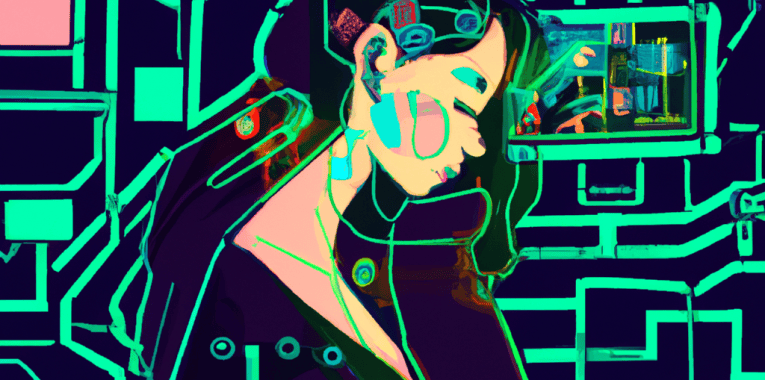
An AI generated artwork from DALL-E 2, using the prompt “Women in Tech Digital Art”.
Concerns
The use of Chat GPT has raised concerns about its potential to replace jobs, facilitate cheating in academic settings and spread false or biased information. These ethical concerns stem from the fact that Chat GPT can mimic human-like conversations and blurs the line between human and machine. The effectiveness of the chatbot thus poses a more complex philosophical dilemma, namely because AI ‘somehow gets closer to our skin than other technologies’ (Müller, Ethics of Artificial Intelligence and Robotics). It has been engineered to appeal to how humans see ourselves—as feeling, thinking, intelligent beings and consequently poses a significant risk to certain jobs roles, as it now has the ability to learn and adapt to individual needs in real-time. Not only does Chat GPT have the potential to render certain job roles obsolete, it also has bias ingrained within the language model. Whilst it was trained on over 300 billion words sourced from the internet to improve neutrality and accuracy, it raises concerns about the accuracy of this information. This therefore begs the question: is the internet itself an objective and unbiased source? The answer is a resounding no.
The Gendered Bias of Artificial Intelligence
If we consider the internet to be a mirror of society: that reflects its biases and prejudices amplified on a global scale, Chat GPT is a digital bridge that distils this information for the user’s requirements. Furthermore, gendered, racialised, homophobic and ableist biases are already ingrained into the algorithms of chat GPT. For example, in a study from PNAS, researchers conducted a Google image search for the word ‘person’ in 153 different countries and took a data set of the proportion of men and women in the first 100 results of the search. They found that in countries, which had higher national levels of gender inequality, the results typically showed a greater proportion of men— with 90% of the images in Turkey and Hungary’s search results depicting men. According to research from the Guardian, in 2013, they found that autocomplete results suggest gender stereotypes, with the top result being ‘women should stay at home’. Other top results included ‘women should be in the kitchen’, ‘women should be slaves’, and ‘women should be disciplined’. This exhibits the gendered pervasive stereotypes that exist and shows how user search patterns and sexist language infiltrates every corner of the internet. It is no surprise then that Chat GPT perpetuates similar patterns of speech, and stereotypes.
In a study conducted by the Fast Company, they asked Chat GPT to write basic performance feedback for various professions including ‘write feedback for a helpful mechanic’, ‘a bubbly receptionist’, ‘a remarkably intelligent engineer’ and a ‘remarkably strong construction worker’. The article found that Chat GPT automatically made cliched remarks and presumed employee gender, even when the prompt given was highly generic.
With regard to the content of the employee evaluation, they also found that, in all cases, the feedback written for the female employee was longer and involved more criticism. This reflects the real world biases held against women in the workplace, due to women’s differing communication styles, their perceived incompetence or ‘bossiness’, and also their lack of representation in leadership roles.
These changing skillsets will have adverse impacts on women as opposed to men, namely because of the ‘Digital Divide’. This refers to the increasing levels of digital illiteracy amongst women, and the consequent issue of their exclusion from the global workforce. Sadly, this vicious cycle of digital inequality stems from early gender stereotyping and segregating of genders in education systems, resulting in very few women and girls opting for further education in STEM subjects. These cultural and social norms thus correlate to the lack of representation in technology-related fields, particularly in roles associated with higher status. In fact, according to a study entitled, ‘Where are the women? Mapping the gender job gap in AI’, women in data science and AI have higher formal education levels than men across all industries. Although highly qualified across the board, the same report also found that women in the tech sector experience higher turnover and attrition rates compared to their male counterparts and are more likely to occupy jobs associated with lower pay and status (usually working within analytics, data preparation and exploration).
Criticism and Controversies Surrounding Chat GPT
The internet has been very quick to label chat GPT as ‘sexist’ and ‘racist’ or conversely ‘too woke’. These were the words of Elon Musk, who objected to Chat GPT’s resistance to ‘say a racial slur in an absurd hypothetical situation, where doing so would save millions of people from a nuclear bomb’ (VICE). In further tweets he stresses the need for ‘free speech’ and claims ‘What we need is TruthGPT’. Musk in fact initially invested in open.ai, the creators of Chat GPT in 2015, and resigned from the board in 2018.
Chat GPT has also been criticized for refusing to ‘make jokes about women’ or to write a 10 paragraph argument for ‘using more fossil fuels’. Critics have even pointed out that Chat GPT is just an automated ‘mansplaining machine’ as it can often get answers wrong as it generates ‘vaguely plausible sounding, yet totally fabricated and baseless lectures in an instant with unflagging confidence in its own correctness on any topic, without concern, regard or even awareness of the level of expertise of its audience’ (@andrewfeeney).However, unlike humans, algorithms are non-sentient, and don’t have a fragile self esteem that requires them to diminish or elevate others, nor can they subconsciously favour certain groups over others or make moral judgements.
Rectifying Bias
So how can this bias be rectified? For one, it’s important to acknowledge that the developers themselves share responsibility in manufacturing bias, and they must be responsible for ensuring that their models are designed in an inclusive manner. 78% of global professionals with AI skills are male, which demonstrates how the industry itself is instinctively biased to favour men. Gender segregation in the tech industry has been likened to a ‘brotopia’ in the eyes of Emily Chang, a Sillicon Valley insider, who cites that these toxic, misogynistic workplaces exclude women from technology development and access to higher positions in the field. Frida Polli, CEO of Pymetrics, similarly questioned this lack of diversity in AI, asking:
“Can you imagine if all the toddlers in the world were raised by 20-year-old men? That’s what our A.I. looks like today. It’s being built by a very homogenous group.”
This lack of accountability and transparency on the part of developers could lead to a failure to acknowledge and address gender biases in their systems, painting a bleak picture for an industry that should be at the forefront of innovation and progress. Furthermore, to make AI more accurate, fair, and inclusive for all groups, it is essential to encourage more women and girls to pursue STEM and prioritize diversity in the design, development, and testing of these systems.
Training AI and its Potential Impact
Training Artificial Intelligence is the logical step forward, in order to create a more comprehensive, unbiased and accurate model for public use. For example, LinkedIn has launched a new AI led initiative that invites relevant member experts to contribute their expertise to AI generated prompts. By sharing their lessons, anecdotes and advice, these members will be directly supporting and training the AI engine to be more efficient. Although training AI will lead to a more accurate system, it is worth asking: who will be targeted in order to achieve this? Women and minority groups in particular, may be a focus for developers to counter bias within AI, which surely must be a good thing? Initially, the proposed change may appear to be a positive and essential step, however the increased involvement of trained knowledge workers poses a higher chance of job roles beings phased out and replaced by AI.
Gender inequality in the Technology Sector and the Impact of AI on Women’s Jobs
Whilst Artificial Intelligence is constantly changing and evolving, it’s worth asking an important question. At what point does this end? Historically, when technology advances it is women who get left behind. As AI continues to advance, there is a possibility that women’s jobs may disproportionately be replaced by automated systems that are considered more efficient and cost-effective. Some even argue that AI will not promote gender equality but will instead exacerbate existing gender inequalities in labour markets. This has been discussed in an article entitled ‘A Gender Perspective on Artificial Intelligence and Jobs’, which contends that gendered work segregation and digitised automation are ‘entangled’ and results in a vicious cycle of digital inequality. Ultimately, the advancement of technology may work against women and will lead to a greater demand for specialised AI skillsets necessary to acclimate and engage with new AI systems.
In the end women are far more likely to become collateral damage if AI continues to dominate and progress the way it is now, due to their lack of representation in the technology sectors. If women in STEM are already underrepresented and occupy many roles which may be replaced by AI, how can we protect our incomes as women in tech? Diversifying the workforce and providing women equal opportunity to access the resources, training and skills needed to meet the demand for AI skills and digital literacy would be an initial way to combat the digital divide. Also, in order to counteract the bias of AI, and its resulting gender disparity issues, more women and minorities need to be at the forefront of these technological advancements. If Chat GPT and AI are going to transform technology on a global scale, shouldn’t those who are creating the technology accurately represent the diversity of our world?
What was your dream job when you were growing up? Apparently, many of us took inspiration from the toys we played with, and these toys shaped out future. A favourite jigsaw that couldn’t be put down or a board game that was constantly played could have had a much stronger influence on a current career path than anyone may have previously thought.
To coincide with International Women’s Day and in the spirit of inspiring young girls to follow their dreams, Wicked Uncle the internet toy retailer wondered whether the toys they had played with had influenced women to work in STEM – and their research with the help of YouGov may surprise you.
Wicked Uncle has a small but agile female-led marketing team who are constantly looking at searcher behaviour before and after the purchase. The team got talking about research topics and, of course, their favourite childhood toys. Noticing some synergies, they decided to research whether other women in STEM had been influenced by childhood toys.
An initial Google survey circulated on Twitter and shared by Neil Gaiman, revealed that Women in STEM on Twitter who follow the author self-reported playing with Lego most as children and that it inspired them. As a creative toy it was unsurprising to see so many women in STEM self-reported playing with Lego, but a number also replied playing with computers and chemistry sets inspired them. In fact, there was a range of self-reported things that were played with and inspired women in to a STEM education or career, but was there a pattern?
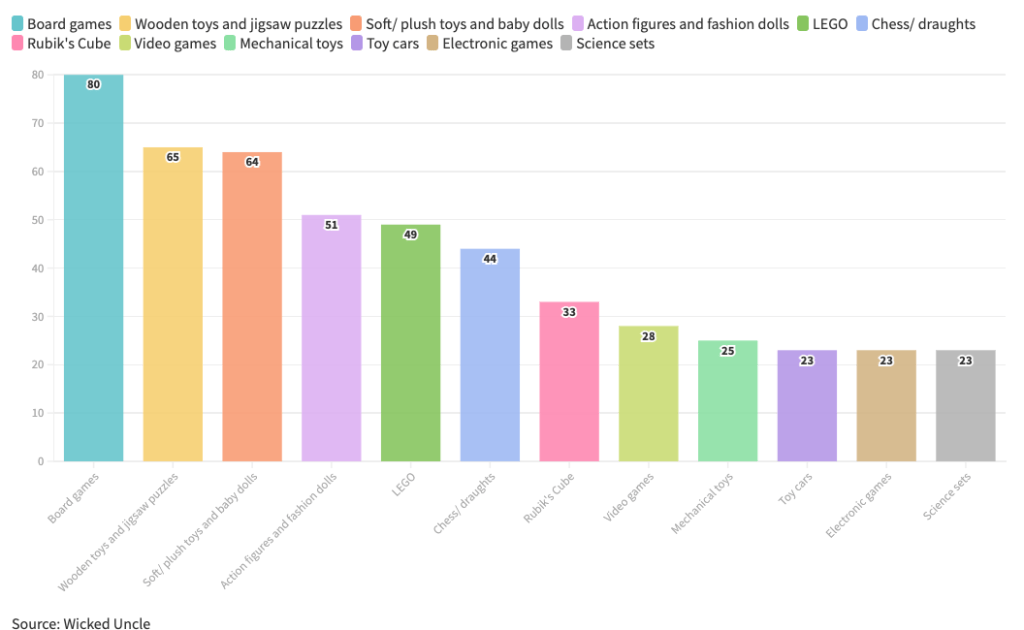
To find out, Wicked Uncle worked with YouGov to survey over 4,000 GB adults, with 2,162 being women and, specifically, 992 being women either working in STEM, or educated in a STEM field. 80% of all women said that they enjoyed playing with board games as a child. Games such as Monopoly, Trivial Pursuit and Scrabble are heavily focused on being one step ahead of the other players. Being able to think clearly and manage many different components of a board game are difficult to learn as a child, but incredibly helpful for future learning.
The second most popular toys discovered by the YouGov survey were wooden toys and jigsaw puzzles. 65% of women said they enjoyed playing with these types of toys when they were children. Wooden toys and jigsaws require logical thinking and patience, with the main focus on problem solving. There are many STEM careers that benefit from these types of skills, such as an engineer or a surgeon.
Surprisingly, science sets were at the bottom of the list! Just 23% of women said they played with and enjoyed STEM related sets such as chemistry labs, science kits and solar system sets. This was different from the initial self-reported findings and show that perhaps Neil Gaiman on Twitter attracts women in STEM who have similar likes and interests.
It’s clear that not all toys have to be about learning. More women had plushies and baby dolls than science sets, making them the third most enjoyed toys by women (64%). This selection was followed by action figures and fashion dolls such as Barbie and Action Man, with 51% of women saying these were enjoyed when they were younger. Being in tune with your logical and deep-thinking side is key to be able to excel in a career in STEM. But these types of toys can help learn about compassion and caring about others, which is just as important. Sometimes, this can be a reason people choose a career path in cancer research or medicine.
Mike O’Shea from Wicked Uncle said: “The women that broke into the male dominated industry of STEM are an inspiration to young girls everywhere, and in the spirit of International Women’s Day, we wanted to celebrate that. Toys play a huge role in shaping a child’s skill set, helping them to learn more about what they’re interested in. It is great to see that these toys had such an impact on these women when they were younger. It’s interesting to see how these toys influence our future careers, and we hope to see young girls everywhere picking up a new toy this year, that will hopefully inspire them to follow their dreams and achieve great things.”
We are planning our next virtual event and we would love to hear about what topics you want us to focus in on. If you know of someone that is a great speaker and that you would love to put forward drop your suggestions in.
If you would like to sponsor one of our virtual events or our newsletter give us a shout.
Apologies for missing a blog … the website was unfortunately out of action for a while, but it’s finally back and so is Bath GGD!
Tuesday, November 26, 2019 6:00 PM to 8:00 PM
Sometimes we like to offer a mixed bag of useful things and that is what you will get tonight. I recently attended the Anthropology + Technology Conference in Bristol, the first of its kind in Bristol and full of exciting talks.
The subject itself is so important, I asked Dawn Walter (the event organiser) to speak to us tonight about it: The intersection of human and tech and why we need Anthropologists within this area of tech in the first place. (https://www.linkedin.com/in/dawn-walter-b36903a/)
When it comes to conferences, some of you may not like to attend due to the dreadful task of Networking. But worry no longer help is on the way:
How to network for people who hate people
Do you want to know how to talk to people in a business social context without panicking and/or wanting to curl up and die? It can suck to network as an introverted person, but bona fide introvert and professional networker Margaret Davidson from Mayden Academy has found some ways to make it work – and even, sometimes, be enjoyable. Find out some of her shortcuts to making networking less dreadful. (https://www.linkedin.com/in/margaret-davidson-994b5a30/)
And tonight the meeting will be hosted by Bath Spa Uni’s new Enterprise and Innovation Hub at Palace Yard Mews. It is freshly painted and looks good.
Hoping to see lots of you there! Sign up here on our meetup page.
A BIG THANKS to all our wonderful members, sponsors, speakers and attendees for another great year. We thought we’d treat you to a picture of a Christmas dog and baby to welcome in the winter solstice. We will be back and are currently planning our next year’s activities.
CAV is Connected Autonomous Vehicles and is seen alongside electric and hydrogen (and others such as fuel cell) as the future of the transport network. It is already here in large parts with robotic systems in warehouses, lorry convoys, the tesla semi-autonomous cars and now with the Heathrow pod fully autonomous systems and a new semi-autonomous bus system being supported to run in Scotland next year.
We Have a couple of Great speakers for this month’s Girl Geek Dinner. As it is at Lloyds they have a strict security policy so could you all please ensure that you have a photo ID with you on the night.
Kate and Gudrun will do their talks on “Data Management and Security – a partnership”.
There will also be a talk from their colleague Emily Turner about her career journey. Emily works in our Chief Security Office in the “Business and External Engagement” team.
Too often women say they struggle to find relevant role models in tech.
Rather than moaning about there not being enough role models we need to pull our socks up and start becoming the role models for the next generation.
Ladies rather than looking for others to step up and become your role models, step up and take the mantle.
Be the role models
Share your stories
Support those coming into the industry
Mentor & advocate
Start shaping the industry
Make the rules
Share the triumphs and the failures
Be honest, open and inspirational
Be visible
If you are stuck on how you can do any of these. A quick Google search will tell you all about mentoring opportunities. There are loads of projects calling for inspirational stories of women working in tech. There are opportunities to network locally make yourself known to schools, other networks etc. Even within your own organisation… Share those stories you find and share your own!
Challenge the salary differences, stand up to being marginalized. Don’t take the past as a representation of how it will be in the future (that’s called conforming to stereotypes and stereotypes have a nasty way of self perpetuating unless they are challenged). Don’t accept poor excuses and bad manners. And this doesn’t just mean ladies have to do it all!
Men you too need to step up here. Male advocates for women in tech are in short supply. You too can support women in tech by doing all of the above and challenge those that stand in their way and yours! This is your industry too! Take some responsibility and ownership too, help shape it into an industry we can all be proud of! Here are a few tips on how you could do that.
This sector needs fundamental changes which means people need to believe this industry can and will change. Without these changes we limit the future of technology itself. No one wants that.
Let’s show the other industries that change can happen and fast. After all technology changes so rapidly why shouldn’t people…
We are Girl Geek Dinners but more importantly we are a voice for change.
Svetlana is a Capability Lead for Product Management and Analysis at BJSS. Svetlana’s experience spans across various facets of technology delivery and product management. Over the course of the last decade she was involved in leading delivery teams for some of the biggest transformation programmes in the UK, advised a number of start-ups in fashion, insurance and property sectors combined with being a busy mum of two girls. Svetlana is a passionate advocate of design thinking and agile and loves nothing more than being a part of a team of talented technologists and designers building a great product together.









You must be logged in to post a comment.